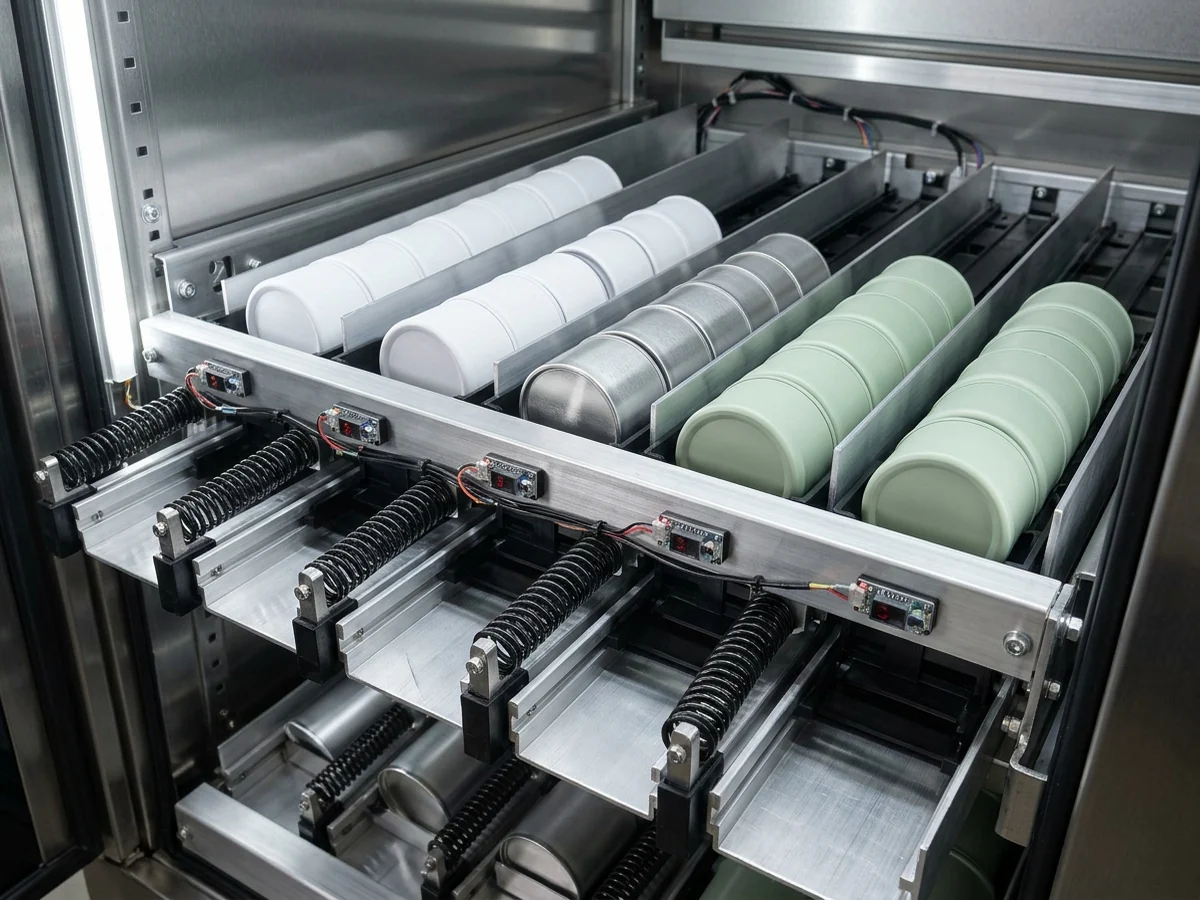
Anyone who has tried loading circular nicotine pouch cans into a refurbished wire-spiral snack vendor or legacy pull-knob cigarette machine encounters the same field failures within the first week: tipped cans, pinched lids, double-vends, and false empty errors. The root cause is basic packaging geometry. Standard commercial pouch tins are circular discs measuring roughly 70 mm across (65–74 mm range across global brands) by only 20–26 mm thick, weighing 25 to 35 grams. They roll when unsupported laterally, lack the rectangular shoulder needed for cigarette chutes, and carry too little mass to trip mechanical drop paddles reliably.
Independent Hardware Notice: PouchVend Systems designs and fabricates neutral commercial vending hardware only and does not sell nicotine or tobacco inventory. Dimensional references to standard 70 mm round pouch cans describe physical package compatibility only; we are not affiliated with, sponsored by, or endorsed by ZYN, Swedish Match, or Philip Morris International.
Mechanical Benchmark: Spring Pushers vs. Wire Spirals vs. Cigarette Chutes
| Mechanical Failure Mode | PouchVend 70 mm Flat Spring-Pusher Deck | Generic Helical Wire Spiral Vendor | Legacy Rectangular Cigarette Dispenser |
|---|---|---|---|
| Lateral Can Stability | Extruded aluminum guide rails hold 65–74 mm round discs upright without tilt | Circular tins rotate or wedge sideways between metal coil pitches | Fixed 88 × 55 mm rectangular chutes let 70 mm discs jam diagonally |
| Thin-Profile Indexing (20–26 mm) | Stepped front polycarbonate stop lip + stepper release indexes single thin cans | Pitch tolerances pinch thin tins or drop two tins on one motor turn | Gravity stack jams when lightweight polymer tins bridge against chute walls |
| Lightweight Drop Sensing (25–35 g) | Dual-beam optical infrared drop gate detects 25 g cans optically in milliseconds | Legacy flap switches frequently miss lightweight cans, triggering false refunds | Purely mechanical delivery with zero electronic confirmation |
| Merchandising Visibility | Constant-force spring presents front can flush against illuminated viewing glass | Front pack recedes deep behind coil after partial sell-through | Blind solid cabinet hides remaining SKU stock and branding |
| Cabinet Depth Efficiency | 230–310 mm wall depth (10–36 lanes) or 520 mm floor depth (48 lanes) | 800–900 mm floor depth required for coil pitch + motor housing | 550–650 mm floor depth with low SKU lane density |
Anatomy of a 70 mm Round-Can Spring-Pusher Lane
Every lane inside PV-SLIM-10, PV-WALL-18, PV-WALL-32, PV-FLOOR-48, and the upper trays of PV-COMBO-36 operates as an independent modular cassette engineered for zero-jam indexing:
- Extruded Aluminum Side Guides: Anodized low-friction rails space each lane cleanly for 65–74 mm diameter circular tins with controlled lateral clearance so cans glide forward without binding or canting.
- Constant-Force Stainless Spring Pusher: Unlike progressive helical push springs that exert crushing force when full and weak force on the final two tins, constant-force stainless steel strip springs maintain uniform forward pressure from can 1 through can 16.
- Transparent Polycarbonate Front Stop Lip: Holds the lead can flush and vertical against the LED-lit viewing glass while allowing the stepper-actuated pusher finger to clear exactly one 20–26 mm tin forward over the sill during dispense.
- Cushioned Delivery Chute & Anti-Fishing Baffle: Guides the released tin cleanly through the optical curtain into the stainless retrieval tray without cracking polymer lids or allowing hand reach up into the tray stack.
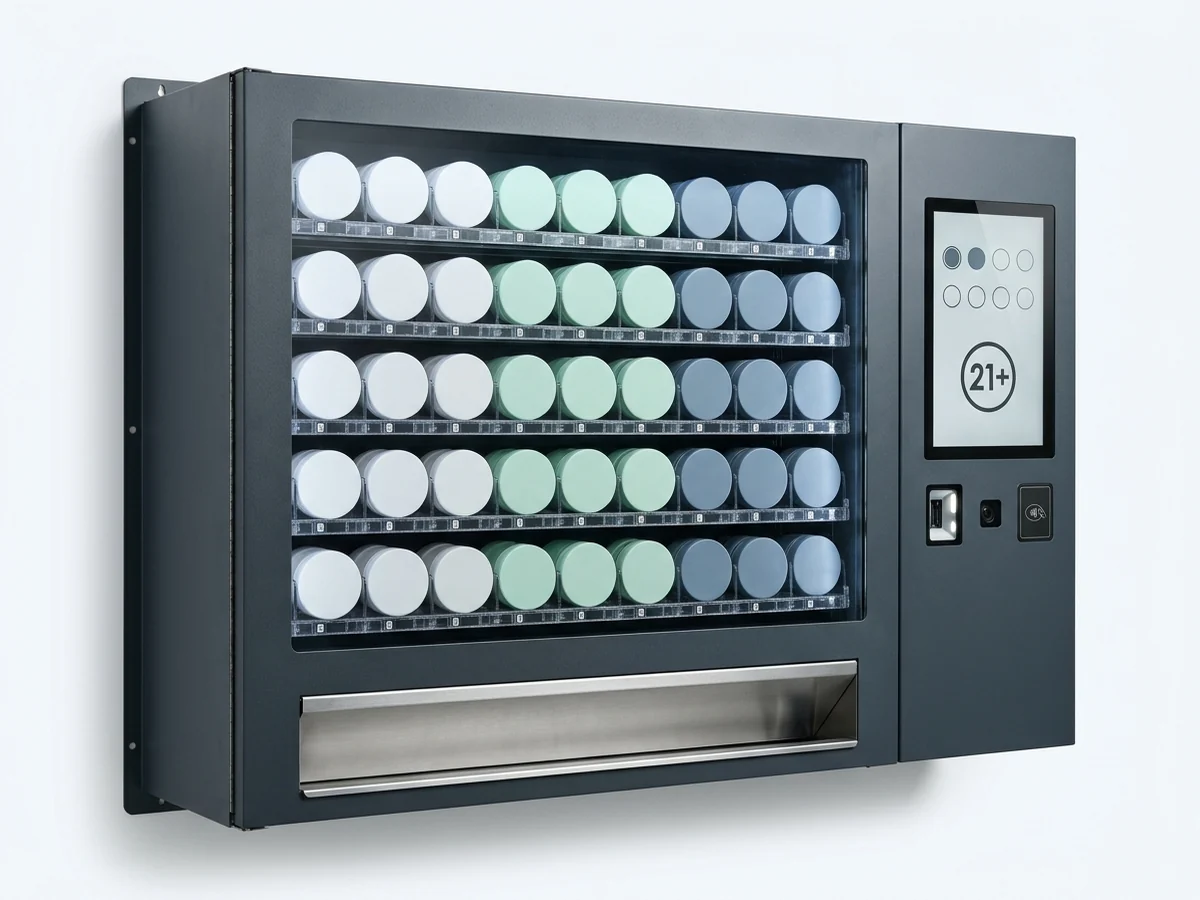
Dual-Beam Optical Infrared Drop Gate and MDB Auto-Void
Even the cleanest mechanical pusher requires closed-loop vend confirmation when operating unattended behind a cashless terminal. Every PouchVend retrieval bay spans a full-width dual-beam (or dual-axis on PV-FLOOR-48) modulated infrared emitter-receiver curtain tuned specifically for small 70 mm × 24 mm silhouettes.
- Verified Delivery: The falling tin breaks the infrared curtain within the vend window, closing the NAMA MDB cashless capture cleanly and decrementing live cloud SKU inventory by 1.
- Automatic Retry & Paired-Lane Failover: If the curtain does not detect exit—for example, due to a misloaded outer cellophane wrapper—the controller executes one controlled micro-advance retry. On multi-lane cabinets like PV-WALL-32 and PV-FLOOR-48, operators link identical fast-moving SKUs across dual lanes so the machine automatically dispenses from the paired backup lane if a primary track hits empty.
- Instant Pre-Authorization Void: If delivery still fails after retry and failover checks, the controller cancels the MDB pre-authorization immediately so the patron is never billed for an undelivered tin, flags the specific lane offline in cloud telemetry, and alerts the route technician.
Tool-Free Hybrid Conversion on PV-COMBO-36
Operators serving mixed 21+ nightlife and boutique hotel locations sometimes want to combine circular pouch tins with rectangular convenience packs—such as charging cables, mint boxes, or breath strips—or preserve hardware adaptability if municipal product ordinances change. PV-COMBO-36 pairs 24 dedicated 70 mm circular can pushers on upper shelves with 12 snap-indexed aluminum box lanes adjustable from 50 mm to 105 mm width without drilling or welding.
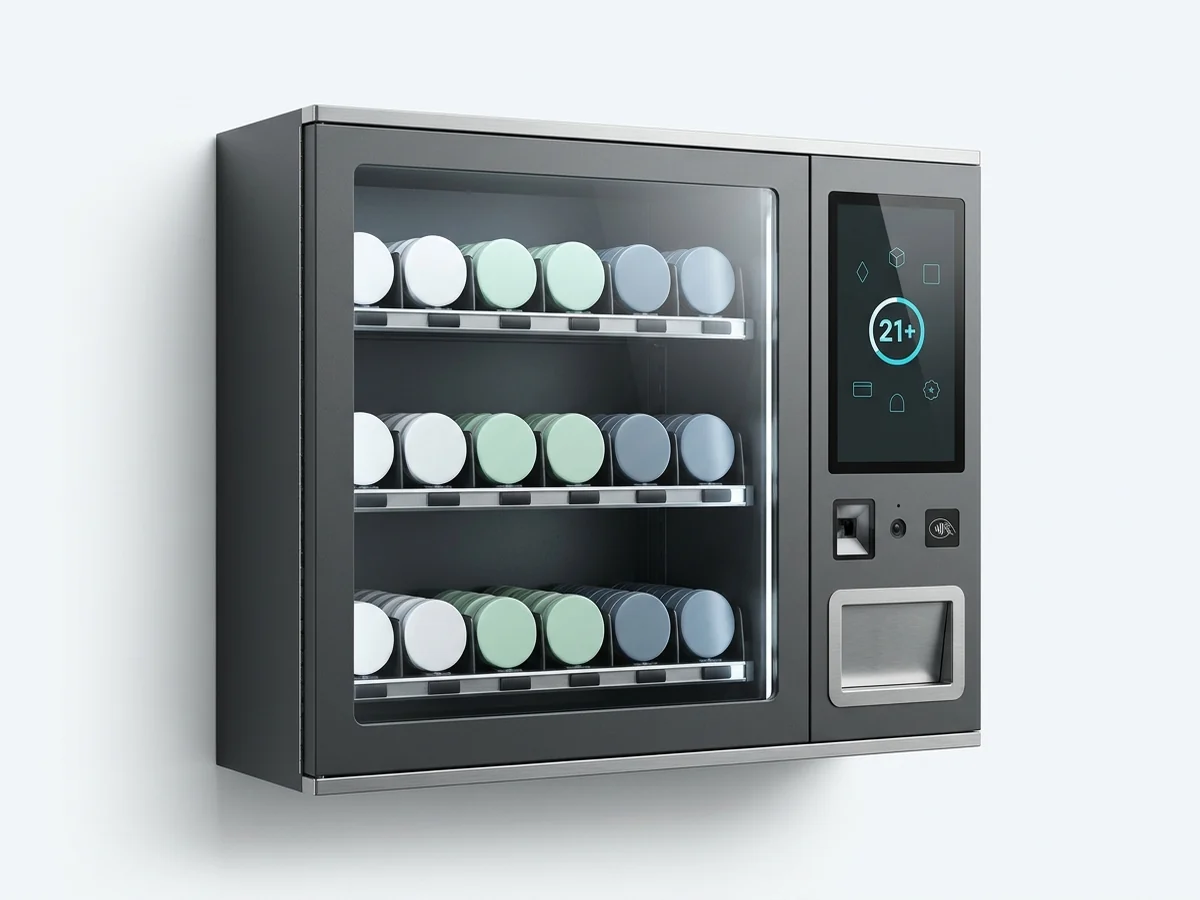
Because every shelf deck plugs into a keyed modular harness, operators can swap or re-index trays during a routine route visit, protecting long-term hardware capital even if venue assortments shift completely away from circular cans.
Sizing Lane Pitch for Your Assortment
Calculating exact loaded capacity uses straightforward pitch math: divide usable track length by nominal tin thickness (typically 24 mm, allowing 1–2 mm stacking clearance). Wall cabinets load 9–12 cans per lane (90–384 total cans), while the 400 mm deep tracks of PV-FLOOR-48 load 12–16 cans per lane (576–768 total cans).
Run your SKU count and weekly can turns through our 70 mm Pouch Vending Lane Capacity Calculator, review complete cabinet specifications on 21+ hardware specifications, or inspect how lane count and tray assemblies influence OEM quotations on pouch vending machine cost factors.
Standard & Custom-Engineered Models
36-Lane Multi-Format 21+ Pouch & Adult Hospitality Kiosk
36-lane hybrid wall/pedestal kiosk (1040×310×960 mm) pairing 24 dedicated 70 mm round-tin lanes with 12 adjustable rectangular box lanes, dual-layer 21+ ID verification, and MDB cashless checkout.