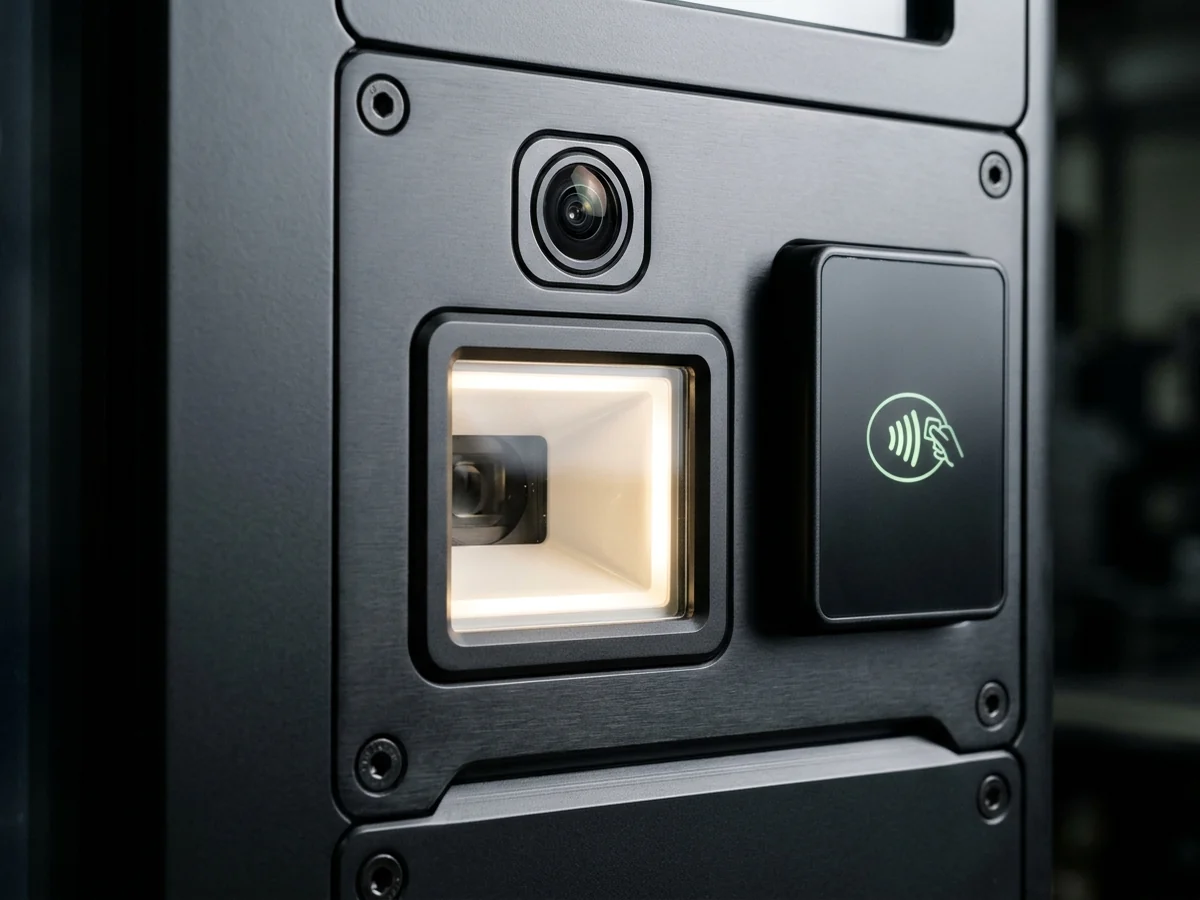
Hospitality patrons inside a 21+ bar or private lounge expect fast age verification—not their driver’s license address, license number, and face portrait uploaded to a third-party cloud database. Equally important for commercial venue operators, storing personally identifiable information (PII) or capturing facial geometry without statutory compliance creates severe legal exposure under state privacy laws. PouchVend Systems engineers its age-verification stack around a zero-retention, local-first volatile RAM architecture so age eligibility executes cleanly on-device without building a persistent customer identity database.
Legal & Engineering Scope: Technical privacy architecture minimizes data collection at the hardware level, but it is not legal advice and does not replace counsel review of state biometric or ID-scanning laws. PouchVend Systems builds independent commercial vending hardware only, sells zero nicotine or tobacco products, and is not affiliated with ZYN, Swedish Match, or Philip Morris International. Confirm statutory notice and consent duties for your jurisdiction with qualified counsel; also review our US 21 CFR 1140.16 compliance overview and website privacy policy.
Volatile RAM Processing Lifecycle (What Enters, What Exits, What Never Persists)
Every PouchVend cabinet—from the 10-lane PV-SLIM-10 to the 48-lane PV-FLOOR-48—executes identity parsing directly on the local embedded controller rather than transmitting raw credentials across the internet for cloud scoring.
| Data Element | Handled In Volatile RAM? | Written to Flash / Disk? | Sent to Cloud CMS? | Immediate Post-Session Action |
|---|---|---|---|---|
| Raw AAMVA PDF417 Barcode String | Yes (milliseconds during parse) | No | No | Memory buffer zeroed immediately after DOB/expiration evaluation |
| Patron Full Name, Street Address, DL Number | Ignored by parser (not extracted) | No | No | Never copied out of transient raw read buffer |
Calculated Age Check (DOB >= 21) & Expiration Status |
Yes (boolean evaluation) | Anonymized pass/fail boolean only | Anonymized pass/fail count + UTC timestamp | Retains compliance event timestamp without patron identity |
| Optional Optical Verification Frame (Mode B only) | Yes (on-device transient frame only) | No | No | Frame & temporary feature vector overwritten immediately upon decision |
| Payment Card PAN / Token | Handled exclusively inside certified third-party MDB reader (Nayax / Cantaloupe) | No | Handled by PCI-certified payment processor | PouchVend controller never touches raw payment card numbers |
Why Local Offline Parsing Matters in Bars and Nightclubs
Cloud-dependent ID verification terminals fail precisely when hospitality traffic peaks: crowded Friday nights when guest Wi-Fi saturates or concrete basement walls attenuate cellular bands. Because PouchVend stores its AAMVA PDF417 version tables (versions 01 through 10 covering US states, DC, and Canadian provinces) locally on the embedded controller:
- Deterministic Sub-Second Parsing: Reading the rear PDF417 symbol and verifying
DBB(date of birth >= 21) plusDBA(non-expired credential) takes less than a second locally, allowing complete ID check plus contactless tap checkout in under 12 seconds. - Resilient Age Gating During Backhaul Dips: Even if telemetry connectivity flickers briefly, the local hardware gate continues enforcing strict 21+ validation rather than failing open or stranding patrons mid-scan. (Cashless EMV authorization still requires active MDB processor connectivity via Ethernet or 4G LTE.)
- Zero Cloud Identity Breach Surface: Because raw driver-license scans and portraits never leave the machine or sit on a central fleet server, there is no pooled patron PII database exposed to remote credential theft.
Addressing Biometric Privacy Statutes (BIPA, CUBI, and State ID-Scan Laws)
Several US states enforce stringent statutory controls on biometric identifiers and electronic driver-license scanning. Most notably, the Illinois Biometric Information Privacy Act (BIPA, 740 ILCS 14) imposes strict written notice, informed release, public retention-schedule, and private-right-of-action rules whenever an entity collects, captures, or stores biometric identifiers such as scans of face geometry. Texas (CUBI), Washington, and state driver-license scan-retention laws (e.g., California, New York, Oregon, and others) enforce distinct limits on how businesses may read or retain barcode data.
To let commercial operators align hardware strictly with legal counsel’s written directive, PouchVend firmware ships with two hard-separated operational profiles (detailed in our ID scanner hardware hub):
- Mode A — Zero-Retention PDF417 Barcode-Only Mode: Physically shutters and firmware-disables the optical verification camera. The cabinet reads only the AAMVA 2D PDF417 barcode to calculate age >= 21 and expiration in volatile RAM, discards the raw string instantly, and logs an anonymized pass/fail event. Operators deploying in strict biometric-consent states commonly select Mode A under counsel guidance so zero facial imaging occurs on the kiosk.
- Mode B — Dual-Layer PDF417 + On-Device Optical Check: Activates the local wide-angle anti-spoof camera alongside the 2D barcode reader to confirm live presence and portrait match strictly inside local volatile RAM without cloud storage or cross-session template retention. Operators enabling Mode B must still verify statutory signage, notice, and written-consent requirements with local legal counsel before activation.
Anonymized Audit Trail Schema for Venue Inspections
When a venue manager or licensing compliance officer asks how the machine verifies age, PouchVend’s cloud CMS exports a clean, privacy-safe operational audit summary containing:
- Cabinet serial ID and venue location tag
- UTC and local timestamp of each verification attempt
- Verification mode active (
PDF417_ONLYorPDF417_OPTICAL_LOCAL) - Outcome code (
PASS_21_PLUS,REJECT_UNDER_21,REJECT_EXPIRED,REJECT_UNREADABLE) - Linked anonymized vend completion status (
VEND_CONFIRMEDorPREAUTH_VOIDED)
No patron name, birthdate string, residential address, driver-license number, or photograph is ever written to the audit log.
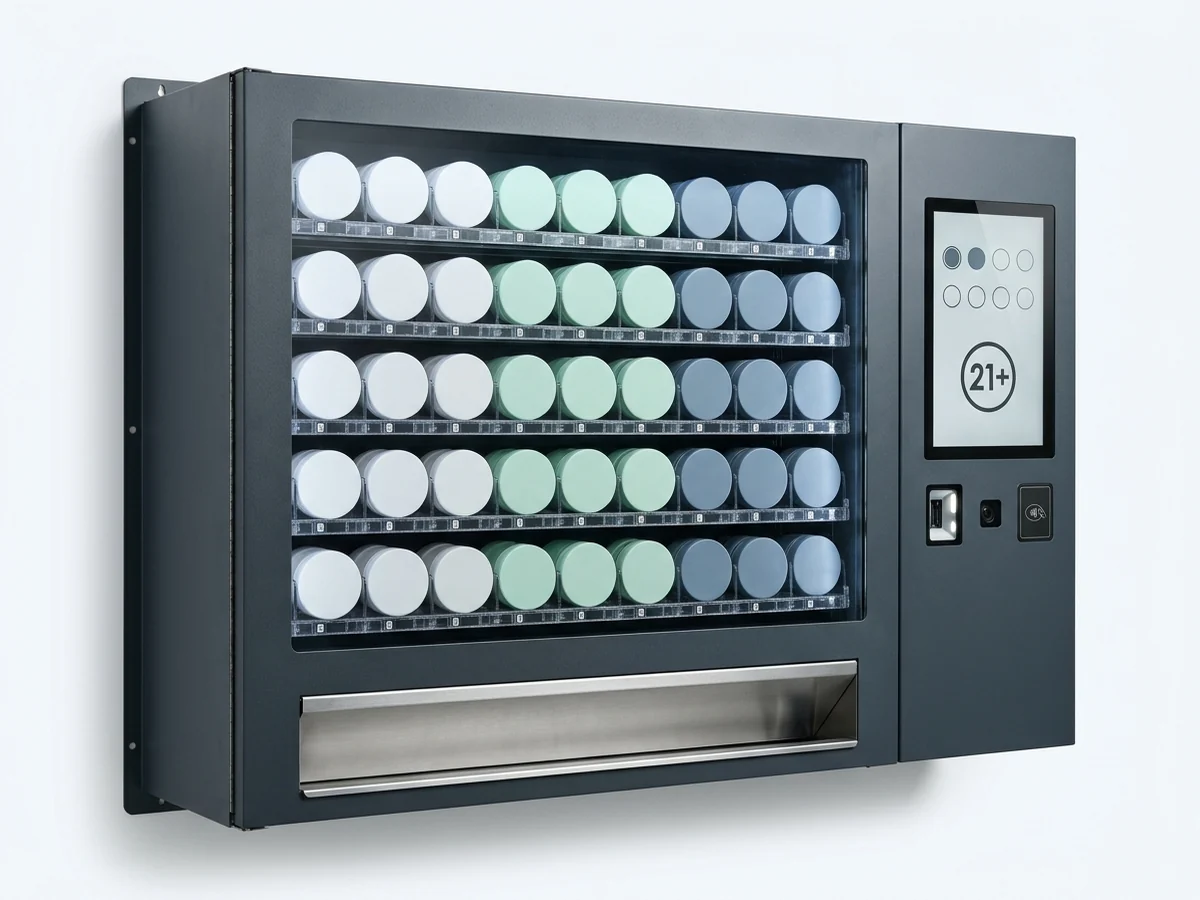
Plan mechanical lane capacity alongside your verification mode using our Pouch Vending Lane Capacity Calculator, inspect full hardware specifications on 21+ hardware specifications, read our governance framework in the editorial and compliance policy, or compare all five cabinets in the 21+ hardware catalog.
Standard & Custom-Engineered Models
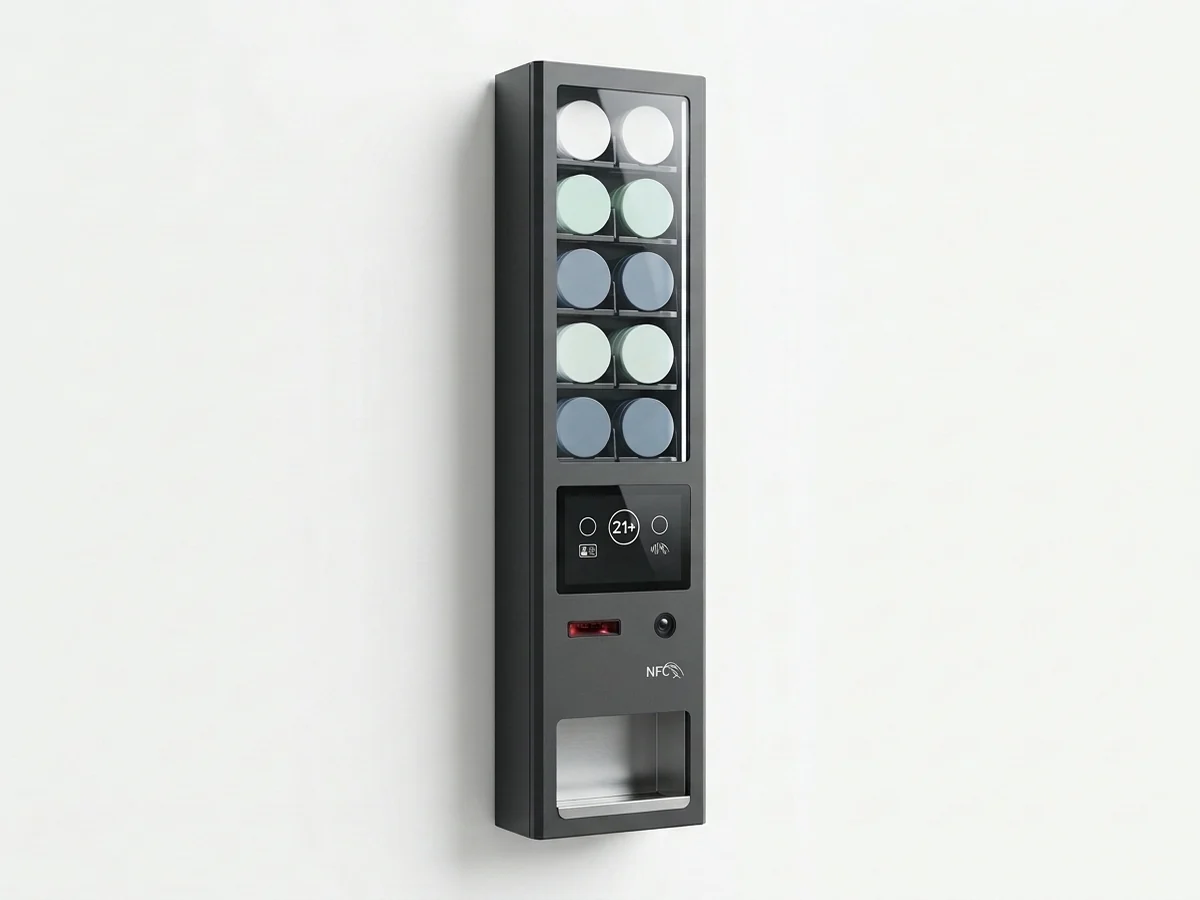
10-Lane Ultra-Slim Wall-Mount 21+ Pouch Dispenser
10-lane vertical ultra-slim wall dispenser (340×230×1080 mm) holding 90–100 cylindrical 70 mm cans with 10.1-inch 21+ screen, integrated ID scanner, optical lens, and contactless NFC reader.